Ascendancy – January to July 2025
From the assertion of sovereignty and cultural magnificence to diplomatic distinction and humanitarian service, the first half of 2025 has unfolded as a golden chapter in the history of the Karno-Ruthenian Empire. Emboldened by strong leadership and guided by a sense of mission, the Empire has strengthened its global presence while deepening national pride and civic virtue.
The year opened with a firm geopolitical statement. On 11 January, the Empire formally denounced the Treaty of Masbahá, effectively asserting the independence of the territory of Takia, a move that underscored the Empire’s enduring commitment to national self-determination.
Shortly after, on 23 January, the Empire became a voting member of the Micronational Hall of Excellence, joining the ranks of the world’s most respected and influential micronations.
Cultural diplomacy made its presence felt when, on 30 January, the Emperor received postcards from Their Highnesses, the Prince and Princess of Aigues-Mortes, and from His Highness, the Archduke of Duckionary—a warm gesture of enduring friendship among sovereign houses.
A historic event followed on 1 February, when Oscar of Karnia and Sania of Freiburg married under imperial law. Sania became Empress, and for the first time in history, the imperial headship was shared between husband and wife, a profound development in both symbolic and practical governance.
The imperial couple continued their public duties with fervor. On 16 February, the Empress returned to Calvi Fortress after a week in Persenburg, during which they met with citizens around the capital and engaged in cultural activities.
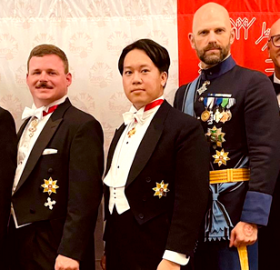
Soon after, on 17 February, the Empire confirmed its second consecutive participation in MICROCON, the world’s foremost micronational summit. Diplomatic recognition and military planning accelerated in tandem. On 20 February, the Imperial Government launched a national campaign to attract volunteers to the Imperial Armed Forces. That same day, Emperor Oscar I was awarded the Grand Cord of the Supreme Order of Sublime Illumination by the sovereign of the Myeong Commonwealth, a distinguished Asian micronation of great cultural refinement.
The next day, on 21 February, the Empire recognized the Sultanate of Huajiangstan, initiating a productive series of relations with Asian micronations.
On 1 March, the Empire’s moral leadership was affirmed when Emperor Oscar I and Prince Brizendine received the Civic Virtue Award from the Republic of Verraland.
March became a month of familial and diplomatic activity. On 21 March, the Emperor traveled to Rio de Janeiro to celebrate the Empress’s birthday with her at Fortress Calvi. On 24 March, the Empress officially celebrated her birthday, surrounded by family and close friends at Fortress Calvi. That same day, she became a full member of all national orders of merit, an honor reflecting her growing role as co-sovereign and public figure.
On 26 March, he held a private meeting with the King of Taslavia, his cousin and fellow sovereign. On 29 March, the Emperor visited the State of Huzul to attend the birthday of his cousin’s daughter, Crown Princess Laura of Huzul, heir to King Eugene and Queen Beatriz.
April began with solemnity and reverence. As Easter approached, the Court of Persenburg entered mourning due the passing of Pope Francis, soon relieved by the joyful announcement of Leo XIV as the new Pope, warmly received by the imperial household.
On 19 April, the Imperial House published official portraits of the Emperors of Karnia and Kings of Pannonia, rendered in the grandiose Pompier-realist style, exemplifying the Empire’s unique cultural identity.
Diplomatic initiatives resumed shortly after. On 21 April, the Empire recognized the Kingdom of Flumenostre, its first Brazilian recognition in six months. The following day, it extended recognition to the Grand Duchy of Hestia.
May brought both institutional consolidation and personal devotion. On 10 May, the Empress returned to Calvi Fortress to spend Mother’s Day with her family, after a week of engagements in Persenburg. On 23 May, the Empress’s Cabinet was formally restructured to handle territorial policies jointly with the Emperor.
Further diplomacy followed swiftly. On 27 May, the Empire recognized the Federation of Koukei and published a concise six-point policy for diplomatic recognition. On 28 May, Cotter Menaceland was recognized.
The month of June opened with great distinction. On 1 June, the Empress assumed command of the Imperial Red Cross, was granted a position in the Academy of Letters, took command of military troops, and was promoted to the rank of Colonel in the Imperial Army, alongside other notable responsibilities.
On 8 June, the Empress visited an agricultural fair in Teresópolis, Brazil, accompanied by her mother, the Dowager Duchess of Calvi, and Countess Neulenburg. A passionate advocate of botany and veterinary science, Her Majesty’s visit exemplified the monarchy’s connection to scientific and rural development. That same day, the Empire recognized the micronation of Chickia, the project of Garrett Gregory Kelley.
On 13 June, the Emperor and Empress were seen attending a charity event at Calvi Fortress, and the Empire recognized the Ootsutsuki People’s Republic Federation, expanding its network in the Asian micronational sphere.
The crowning event of the semester came in late June at MICROCON 2025, where the Empire made its presence felt in historic fashion. The Nemean Games, the micronational equivalent of the Olympics, began on 27 June and Prince Brizendine brought home the silver medal in the 50-meters dash. During MICROCON, the Empire extended recognition to the Republic of New Rubix, the Unitary Republic of Curnon, and the Quackers Kingdom, while deepening relations with the Principality of Sylvestria, the Kingdom of Fergus, and the Cycoldian Imperium.
MICROCON also provided a unique opportunity to renew longstanding friendships with micronational allies such as the Commonwealth of Dracul, the Grand Duchy of Flandrensis, the Republic of Molossia, the Grand Duchy of Westarctica, and the Principality of Aigues-Mortes, the future host of Microcon Europe 2027, an event to which the Empire has already confirmed its participation.
In the midst of this vibrant diplomatic activity, on 28 June, the Empire extended heartfelt congratulations to its friend and ally, the Kingdom of Quinta Velha, on its assumption of a new term as Secretariat-General of the Conference of Santiago, further strengthening a partnership rooted in shared values and strategic collaboration.
As the curtain falls on the first semester of 2025, the Karno-Ruthenian Empire stands elevated—strengthened by diplomacy, crowned in cultural glory, and steadfast in its mission. In a world of change, it remains a beacon of continuity, purpose, and imperial dignity.

Triumph – August to December 2023
At the beginning of August, celebrations for Empire Day reached their peak through an increasingly short List of Honors, although this short list had one big new feature – the victory titles given to the representatives of the Empire at Microcon 2023.

The preponderance of intermicronational foreign policy was proven not only in the largest micronational event on the planet, but also with the creation of the BEM Group, a political and cultural association in partnership with Chesgariya-Litvania for micronations with identity elements focused on Central Europe and which is named in honor of Józef Bem – hero in Hungary and Poland, as well as involved in wars for freedom and self-determination of people in Europe and America.
With his popularity rising at a time of little participation in the Empire’s internal politics, Oscar I celebrated his birthday publicly for the first time, with Ruthenian citizens and in contact with Delveran citizens, who through Consul Casey Pemberton, granted him the Order of Liberty, First Class. In addition to a brief appearance at the traditional Saint Stephen’s Mass on August 20, the following day he was guest of honor at the wedding of his cousin, the Archduchess Beatrice, to the Count Santory of Saxa-Gondomar. With the marriage approved, the Order of the Three Golden Fleeces was guaranteed to the groom.
In September, Court events set the pace, with parties at the Hochbach Residence led by the head of the imperial judiciary and coordinated by the Minister of Culture, Count Szentmária – who also received the Order of the Three Golden Fleeces.

But imperial governance was not just about parties, and the General Staff, in partnership with Pembingham’s, developed the first micronational military ration in history, raising the professionalism of the imperial defense forces so that there is practically no comparison with our power and capacity not only for reaction, but for mobilization, coordination and planning in the defense sphere.
October, however, was a month of varied tensions – Israel’s War against Palestine and the general repercussion of the issue led the Empire to position itself, as always, for peace, but without negotiations with terrorists. In addition to politics, the Imperial House saw one of its oldest and most charismatic members, Archduke Otto, undergo surgeries whose recovery took more than a month and were completed in Arigrade, capital of the Kingdom of Pannonia. However, everything was resolved positively and the month concluded with an auspicious and promising rapprochement with the Commonwealth of Dracul.

The sport acquired interesting proportions in this final part of the year. Usually a neglected subject, sport entered the Court’s activities and the first unofficial fencing tournament took place in the Empire, under the auspices of the Karno-Ruthenian Fencing Federation, founded in 2017. The positive repercussion of the event led the Emperor to start his training more intensely in December 2023.
Delvera’s capital, Clarksbourg, has joined the sister city program with Dracul’s capital, Bran District, at the beginning of November, shortly before the last medal of the Nemean Games was won by the Empire in Hearts of Iron, for the brilliant campaign of Prince Brizendine, worthy of first place. This grand beginning, however, would soon be overshadowed by the sequence of State meetings led by the Emperor as host of the Emperors of Villa Alicia, who visited the monarch Karno-Rutheno on 13 November and the Prince of Aigues-Mortes and the Duke of Constance, who visited him on 16 November. At the beginning of December, it was the Emperor’s turn to receive the King of Braspor.

Oscar I and Jean-Pierre IV. 
Leonardo I and Oscar I.
As the end of the year approached, activities tended to slow down – or so it was expected. The Antarctic Micronational Union completed 15 years with a great speech by its Secretary General, Yaroslav Mar, President of Lostisland, and the Emperor attended the Christmas Concert of the Brazilian Imperial Family – and this as a prelude to another meeting (much more relaxed and informal) with the Grand Duke of Westarctica.

Matheus I and Oscar I. 
Travis I and Oscar I.
After this meeting, the December honors list was issued and the Emperor left for Pannonia, to visit his parents who today reign over the micronation and other relatives of the imperial family, along all the northern regions of Ruthenia – the most important state visit of the reign of Oscar I until today.
In itself, this visit was seen as the starting point of the celebrations marking the ten years of Oscar I’s reign, highlighted not only by the success of the trip, but also by the occurrence of an unprecedented event – the first meeting between micronationalists in the Brazilian state of Piauí . Oscar I received Mateus I de Narvition at the airport in the capital of Piauí, Teresina, for a few hours before his return to Persenburg. The result was positive and both monarchs assured that they would meet in São Paulo in 2024.
With a lot of collective effort, the Empire reaped the laurels of its activity focused on work followed by results and solidified its position as one of the largest micronations of its time.